

How to Start a Contents Restoration and Packout Company
Starting a contents restoration and packout company can be one of the most valuable opportunities in the restoration industry. Contents restoration includes packing, inventorying, transporting, storing, cleaning, deodorizing, drying, restoring, and returning personal property after fire, smoke, water, mold, or disaster damage.
For many restoration contractors, contents restoration is the missing piece of the business. A company may already handle emergency services, mitigation, reconstruction, or structural drying, but if they are not handling contents, they may be losing a major portion of the claim to another vendor.
What Is a Contents Restoration and Packout Company?
A contents restoration and packout company specializes in handling personal belongings and business property after a loss. These items may be affected by smoke, soot, water, odor, mold, debris, contamination, or demolition work inside the structure.
The job of a contents restoration company is to safely remove, document, clean, restore, store, and return these items whenever possible. This may include everything from dishes, tools, clothing, electronics, collectibles, artwork, furniture, office equipment, sports equipment, toys, books, and household goods.
A professional contents operation protects the customer’s belongings while helping insurance carriers reduce replacement costs. It also gives restoration contractors another profitable service line that can be added to fire, water, mold, and reconstruction work.
Why Contents Restoration Is a Strong Business Opportunity
Many restoration companies focus heavily on the structure and leave contents work to outside vendors. This creates a major opportunity for companies that are willing to build a professional contents division.
Adding contents restoration and packout services can help your company:
- Capture more revenue from each fire, water, or mold claim
- Reduce outsourcing costs
- Improve control over the customer experience
- Offer a more complete restoration service
- Build stronger relationships with adjusters and property managers
- Create additional billable services beyond mitigation and reconstruction
- Improve customer satisfaction by restoring sentimental belongings
- Differentiate your company from competitors that only handle structural work
Services a Contents and Packout Company Can Offer
Emergency Packout
Removing contents quickly from a damaged property to protect them from additional smoke, water, mold, demolition, or construction damage.
Inventory and Documentation
Photographing, listing, labeling, and tracking items by room, box, condition, and location to protect the customer, contractor, and insurance carrier.
Contents Cleaning
Cleaning hard contents, soft contents, tools, household goods, furniture, collectibles, and other salvageable items affected by smoke, soot, water, or odor.
Ultrasonic Cleaning
Using ultrasonic cleaning equipment to clean detailed items faster and more consistently than hand cleaning alone.
Electronics Restoration
Cleaning, drying, inspecting, and testing certain electronics and components when proper procedures and training are followed.
Deodorization
Removing smoke, soot, protein fire, musty, and water damage odors from contents using cleaning, drying, ozone, hydroxyl, or other deodorization methods.
Storage
Storing cleaned and uncleaned contents in a secure, organized, climate-controlled facility while repairs are completed.
Packback
Returning cleaned items to the property after repairs are complete and placing them back by room or customer preference.
Step 1: Build a Business Plan
Before buying equipment or hiring employees, create a business plan for your contents and packout division. This does not need to be complicated, but it should clearly explain what services you will offer, who your customers are, what equipment you need, how jobs will be billed, and how the work will flow through your facility.
Your Business Plan Should Include:
- Target customers: homeowners, insurance carriers, adjusters, property managers, plumbers, and restoration contractors
- Service area and response time
- Startup budget
- Facility needs
- Vehicles and storage needs
- Packout supplies and inventory system
- Cleaning equipment
- Staffing requirements
- Training requirements
- Pricing and billing strategy
- Marketing plan
- Quality control process
Step 2: Understand Licensing, Insurance, and Compliance
Requirements vary by state, province, and local jurisdiction. Before offering contents restoration or packout services, confirm what licenses, business registrations, insurance policies, and safety requirements apply in your area.
Common Business Requirements May Include:
- Business license or contractor registration
- General liability insurance
- Workers’ compensation insurance
- Commercial auto insurance
- Warehouse or storage insurance
- Care, custody, and control coverage
- Pollution or mold-related coverage, if applicable
- Written safety procedures
- Employee PPE and hazard communication training
Step 3: Choose the Right Facility
A contents restoration company needs enough space to receive, sort, clean, dry, deodorize, store, and return contents. The facility does not have to be huge when starting out, but it must be organized.
Helpful Facility Areas
- Receiving area for incoming contents
- Dirty contents storage area
- Sorting and triage area
- Pre-cleaning area
- Ultrasonic cleaning area
- Rinse and drying area
- Electronics drying and inspection area
- Deodorization area
- Clean contents storage area
- Packback staging area
- Customer review or inspection area
- Office area for job files and documentation
Facility Features to Consider
- Overhead door access
- Secure storage
- Climate control
- Good lighting
- Electrical capacity for equipment
- Water supply and drainage
- Ventilation
- Racking and shelving
- Room for carts, conveyors, and staging tables
Step 4: Set Up Your Packout System
Packout is one of the most important parts of contents restoration. If the packout is disorganized, the entire job becomes harder. Poor packout procedures can lead to lost items, billing disputes, unhappy customers, and wasted labor.
A Proper Packout System Should Include:
- Pre-job walkthrough
- Room-by-room organization
- Photo documentation before items are moved
- Condition notes for damaged or fragile items
- Item labeling
- Box numbering
- Barcode or QR tracking, when available
- Separation of salvageable and non-salvageable items
- Customer approval process for questionable items
- Chain of custody from job site to facility
Common Packout Supplies
- Moving boxes in multiple sizes
- Dish packs
- Bubble wrap
- Packing paper
- Stretch wrap
- Furniture pads
- Zip bags for small items
- Labels and markers
- Barcode labels
- Tape and tape guns
- Moving carts and dollies
- Plastic totes
- Wardrobe boxes
- Evidence bags for high-value items
Step 5: Create an Inventory Management Process
Inventory management is the backbone of a contents restoration company. Every item must be tracked from the time it is removed until it is returned, disposed of, or paid out as non-salvage.
Your inventory process should answer these questions at all times:
- What item is it?
- Where did it come from?
- What room was it in?
- What condition was it in before cleaning?
- Was it cleaned, deodorized, dried, or disposed of?
- Where is it stored now?
- Has it been returned to the customer?
Inventory Documentation Should Include:
- Customer name and job number
- Room location
- Box number
- Item description
- Photos
- Condition notes
- Cleaning status
- Storage location
- Final disposition
Step 6: Buy the Right Equipment
The equipment needed depends on your volume, budget, and service offering. Some companies start with basic packout and hand cleaning, while others build a full production facility with ultrasonic cleaning, rinse stations, drying systems, deodorization, electronics restoration, and organized storage.
Basic Startup Equipment
- Work tables
- Industrial shelving
- Storage racks
- Rolling carts
- Dollies
- HEPA vacuums
- Hand cleaning supplies
- Microfiber towels
- Brushes and detail tools
- Sprayers and pump-up sprayers
- Drying racks
- Fans and air movers
- Dehumidifiers
- PPE
Production Cleaning Equipment
- Ultrasonic cleaning system
- Pre-wash station
- Rinse station
- Tunnel dryer
- Basket system
- Roller conveyors
- Cleaning solution storage
- Water filtration
- Drying room equipment
- Ozone or deodorization chamber
Electronics Restoration Equipment
- Electronics workbench
- ESD-safe tools and mats
- Drying cabinet or controlled drying room
- Air movers
- Dehumidification
- Cleaning brushes
- Inspection lighting
- Testing and documentation area
Step 7: Understand Ultrasonic Cleaning
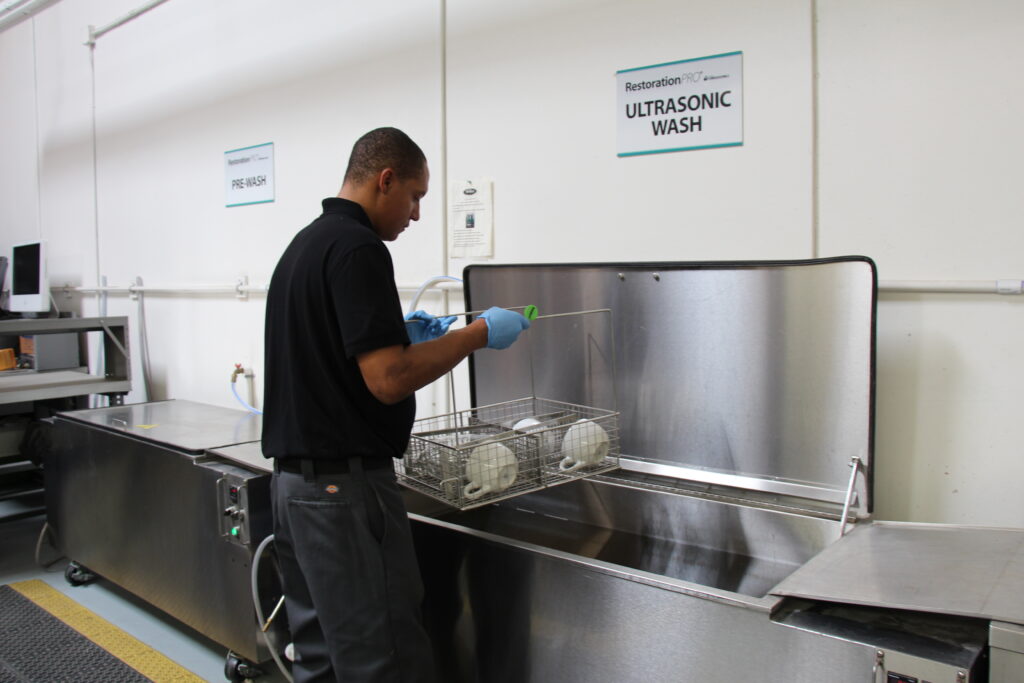
Ultrasonic cleaning is one of the most important tools for a production contents restoration company. It uses high-frequency sound waves to create cavitation bubbles in a cleaning solution. These bubbles help remove soot, smoke residue, oils, dirt, and contaminants from detailed surfaces.
For contents restoration, ultrasonic cleaning can dramatically reduce hand-cleaning labor. Items that may take several minutes to scrub by hand can often be cleaned more efficiently in batches when the correct process is used.
Items Commonly Cleaned with Ultrasonics
- Kitchen contents
- Glassware
- Ceramics
- Tools
- Hardware
- Decorative items
- Collectibles
- Small non-porous items
- Light fixtures
- Metal items
- Certain electronics components when properly trained
Ultrasonic Cleaning Variables
- Time
- Temperature
- Cleaning solution
- Frequency
- Power
- Basket loading
- Soil level
- Material type
- Rinsing
- Drying
Step 8: Build a Cleaning Workflow
A contents restoration company should operate like a production line. The more organized the workflow, the more items your team can process with less confusion and less wasted labor.
Example Contents Cleaning Workflow
- Receive contents at facility
- Verify job number and inventory
- Stage dirty contents by job and room
- Separate salvageable, questionable, and non-salvageable items
- Pre-clean heavy debris or loose soot
- Clean items by category and material
- Rinse items when required
- Dry items completely
- Deodorize if needed
- Quality control inspection
- Repack cleaned contents
- Move to clean storage
- Prepare for packback
Step 9: Plan for Fire, Smoke, Water, Mold, and Odor
Contents restoration companies handle many different types of losses. Each loss type requires a different approach.
| Loss Type | Common Challenges | Important Considerations |
|---|---|---|
| Fire and Smoke | Soot, odor, acidic residue, heat damage, fragile items | Separate light, medium, and heavy soot. Use proper cleaning chemistry and deodorization. |
| Protein Fire | Strong odor, greasy residue, difficult-to-see contamination | Requires detailed cleaning and odor control. Items may look clean but still hold odor. |
| Water Damage | Wet contents, staining, swelling, microbial growth risk | Dry quickly, document condition, separate porous and non-porous items. |
| Mold | Contamination, safety concerns, possible disposal | Follow proper PPE, containment, cleaning, and disposal procedures. |
| Odor Loss | Smoke, musty smells, sewage, pets, chemical odors | Cleaning must come before deodorization. Do not rely on odor treatment alone. |
Step 10: Add Electronics Restoration Carefully
Electronics restoration can become a strong profit center, but it requires training, careful handling, and documentation. Electronics should not be treated the same as standard hard contents.
Electronics Restoration May Include:
- Photo documentation
- Initial condition inspection
- Battery removal
- Disassembly when appropriate
- Cleaning of components
- Controlled drying
- Corrosion inspection
- Reassembly
- Testing and documentation
Step 11: Hire and Train the Right Team
A contents restoration company needs organized, detail-oriented employees. The best contents technicians are careful, patient, and good at following procedures. They also need to understand that customers may be emotionally attached to the items being handled.
Common Positions in a Contents Company
- Contents manager
- Packout supervisor
- Inventory technician
- Cleaning technician
- Ultrasonic cleaning technician
- Electronics technician
- Warehouse manager
- Estimator or billing specialist
- Customer communication coordinator
Employees Should Be Trained On:
- Customer communication
- Job site safety
- PPE
- Packout procedures
- Inventory documentation
- Cleaning methods
- Ultrasonic cleaning
- Electronics handling
- Deodorization
- Quality control
- Storage procedures
- Packback procedures
Step 12: Get Professional Contents Restoration Training
Training is one of the most important investments a contents restoration company can make. Many companies buy equipment but never learn how to build a profitable system around it. That often leads to slow production, damaged items, underbilling, and frustrated employees.
Professional training helps your company build repeatable procedures for packout, inventory, cleaning, ultrasonic processing, electronics restoration, deodorization, billing, and workflow design.
Training Should Cover:
Packout Operations
How to organize the job site, document rooms, pack efficiently, protect fragile items, label boxes, and maintain chain of custody.
Inventory Management
How to track items from the property to the facility and back using photos, room names, box numbers, labels, and status updates.
Ultrasonic Cleaning
How to use ultrasonic tanks, baskets, cleaning solutions, temperature, dwell time, rinsing, and drying for contents restoration.
Electronics Restoration
How to safely handle electronics, remove batteries, clean components, dry items, inspect for corrosion, and document results.
Workflow Design
How to lay out your facility so dirty contents, clean contents, drying, deodorization, and storage areas do not create bottlenecks.
Billing and Estimating
How to document labor, cleaning steps, packout time, storage, deodorization, and specialty services so the job is billed properly.
Omegasonics Contents Restoration Training
Omegasonics provides contents restoration training for companies that want to start, grow, or improve a contents and packout division. Training can be customized for companies that are brand new to contents restoration or for experienced companies that want to improve production, workflow, ultrasonic cleaning, electronics restoration, and profitability.
Training may be available onsite or through Zoom, depending on your company’s needs. Onsite training allows your team to train inside your own facility, using your space, your workflow, your employees, and your equipment. Zoom training can help owners, managers, and technicians understand the process before investing in equipment or expanding services.
Omegasonics Training Can Include:
- Packout and contents handling
- Inventory procedures
- Ultrasonic contents cleaning
- Electronics restoration
- Cleaning chemistry
- Drying procedures
- Production workflow
- Facility layout recommendations
- Quality control
- Insurance documentation
- Billing strategies
- Marketing your contents division
Step 13: Create Standard Operating Procedures
Written procedures help every employee follow the same process. Without SOPs, each technician may clean, pack, label, or document items differently. That creates confusion and inconsistent results.
Recommended SOPs
- Job intake procedure
- Customer communication procedure
- Packout procedure
- Inventory procedure
- Photo documentation procedure
- Non-salvage procedure
- Ultrasonic cleaning procedure
- Electronics restoration procedure
- Textile handling procedure
- Deodorization procedure
- Quality control procedure
- Storage procedure
- Packback procedure
- Billing documentation procedure
Step 14: Understand Billing and Estimating
Contents restoration must be documented properly to be billed properly. Many companies lose money because they perform the work but do not document the labor, equipment, supplies, storage, cleaning steps, or specialty services clearly enough.
Common Billable Services
- Emergency packout labor
- Inventory and documentation
- Boxing and packing materials
- Transportation
- Storage
- Manipulation of contents
- Cleaning labor
- Ultrasonic cleaning
- Deodorization
- Electronics restoration
- Textile handling
- Disposal of non-salvage items
- Packback labor
Step 15: Market Your Contents and Packout Company
Marketing contents restoration requires education. Many customers and referral sources do not fully understand what can be restored. Your marketing should explain the value of restoring contents instead of replacing everything.
Marketing Targets
- Insurance agents
- Adjusters
- Property managers
- Plumbers
- Fire departments
- Real estate professionals
- Restoration companies that do not offer contents cleaning
- Commercial property owners
- Schools, churches, and municipalities
Marketing Ideas
- Create a contents restoration page on your website
- Create a packout services page
- Show before-and-after photos
- Post ultrasonic cleaning videos
- Offer facility tours
- Create educational posts about fire contents cleaning
- Promote electronics restoration
- Build relationships with adjusters and agents
- Send email campaigns to property managers
- Use Google Business Profile photos and updates
Step 16: Focus on Customer Communication
Contents restoration is emotional. Customers may have just experienced a fire, flood, or major loss. Their belongings may include family photos, heirlooms, collectibles, business records, and sentimental items. Communication must be clear, professional, and compassionate.
Customers Should Understand:
- What items are being removed
- Where items are being stored
- How items are tracked
- What can likely be restored
- What may be non-salvageable
- How long the process may take
- How they will receive updates
- When packback may happen
Step 17: Create a Quality Control Process
Quality control protects your reputation. Every cleaned item should be inspected before it is repacked or moved to clean storage.
Quality Control Checklist
- Was the item cleaned properly?
- Is there visible soot or residue remaining?
- Does the item still have odor?
- Is the item dry?
- Was the item damaged during cleaning?
- Was pre-existing damage documented?
- Was the cleaning status updated?
- Was the item repacked in the correct box?
- Was the item moved to the correct storage location?
Startup Checklist for a Contents Restoration and Packout Company
Before Taking Your First Job
- Create your business plan
- Verify licensing and insurance
- Choose your facility or storage space
- Set up shelving and storage zones
- Purchase packout supplies
- Select inventory software or tracking method
- Create job forms and documentation templates
- Buy cleaning equipment and supplies
- Train employees
- Create SOPs
- Build your pricing and billing process
- Create a marketing plan
- Set up customer communication procedures
- Establish quality control standards
Common Mistakes to Avoid
- Starting without training
- Buying equipment without designing the workflow
- Not documenting items before moving them
- Mixing dirty and clean contents
- Failing to separate non-salvage items
- Not tracking box numbers and room locations
- Using the wrong cleaning solution
- Allowing untrained employees to clean electronics
- Not drying items completely
- Underbilling labor and supplies
- Failing to communicate with customers
- Not performing final quality control
Is a Contents Restoration Company Profitable?
A contents restoration company can be very profitable when it is built correctly. Profitability depends on training, workflow, equipment, documentation, billing, production speed, and the ability to restore items efficiently.
Companies that rely only on hand cleaning often struggle with labor costs. Companies that combine trained employees, organized packout procedures, ultrasonic cleaning, proper drying, deodorization, and accurate billing are better positioned to build a profitable contents division.
Final Thoughts
Starting a contents restoration and packout company is not just about cleaning damaged belongings. It is about building a professional system that protects customers, supports insurance claims, restores salvageable items, and creates a profitable service line for your business.
The companies that succeed are the ones that invest in training, equipment, inventory control, workflow, documentation, customer communication, and quality control. With the right systems in place, contents restoration can become one of the most valuable divisions in your restoration company.
Get Contents Restoration and Packout Training From Omegasonics
Whether you are starting a new contents restoration company or improving an existing packout and contents cleaning operation, Omegasonics can help your team build a more efficient, profitable, and professional system.
Training is available for packout operations, inventory management, ultrasonic cleaning, electronics restoration, workflow design, cleaning chemistry, quality control, insurance documentation, and production efficiency.
Email Omegasonics
Request a Quote
Email:
Phone: 888-989-5560
“`