

Understanding the New Manufacturing Frontier
In the automotive world, companies like Rivian are rewriting the manufacturing playbook — not with heavier machinery, but with faster iteration, smarter workflows, and technologies that eliminate bottlenecks across design, prototyping, and production. A recent showcase by Rivian and Stratasys spotlighted how additive manufacturing (3D printing) is collapsing traditional development cycles — fundamentally changing how vehicles are designed and brought to market.
While 3D printing accelerates part creation, another technology quietly enables manufacturers to realize the full value of those parts on the production floor: industrial ultrasonic cleaning.
Here’s how ultrasonic cleaning — especially when deployed with industry-leading systems like those from Omegasonics — amplifies every modern manufacturing advantage:
1. Faster Prototyping Meets Cleaner Production
Rivian’s engineering team “needs ways to iterate quickly without getting locked into slow, expensive processes.” That’s precisely where flexible cleaning capabilities become crucial.
Before a prototype — especially one created through additive manufacturing — can be tested or assembled, it must be immaculately clean:
-
Residual powders from 3D-printed parts
-
Oils, greases, or process contaminants
-
Microscopic debris in complex geometries
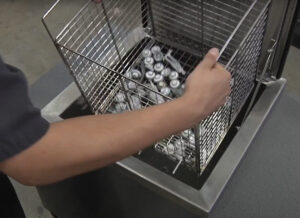
Ultrasonic cleaning offers a repeatable, thorough, and non-abrasive way to prepare parts for functional testing, quality inspection, or final assembly. Omegasonics systems use high-frequency sound waves in liquid to reach deep into intricate geometries and voids that traditional cleaning simply cannot access.
This matters because speed without precision results in defects — but precision without speed stalls production. Ultrasonic cleaners bridge that gap.
2. Prototyping to Production — A Seamless Transition
Additive manufacturing isn’t just about printing parts — Stratasys emphasizes that the real value is in eliminating tooling, accelerating testing, reducing inventory, and enabling faster decisions.
Ultrasonic cleaning complements this shift.
When engineers refine designs and print components, ultrasonic cleaning:
-
Prepares parts immediately for testing
-
Enables rapid inspection without manual hand cleaning
-
Ensures repeatable quality across batches
-
Accelerates feedback loops in iterative design
Instead of parts being delayed on cleaning benches, they flow quickly into evaluation and iteration — fully aligned with the agile mindset that forward-looking manufacturers like Rivian champion.
3. From Aerospace to Automotive — Cross-Industry Precision
Ultrasonic cleaning isn’t unique to automotive — it’s trusted across industries where precision matters:
-
Aerospace components with tight tolerances
-
Medical instruments needing surgical cleanliness
-
Electronics with delicate circuitry
-
Industrial parts with complex internal geometries
When manufacturers adopt rapid prototyping strategies like additive manufacturing, they also confront new challenges in preparing those parts for real-world use. Traditional cleaning (manual scrubbing, solvent baths, rinsing) is:
❌ slower
❌ less consistent
❌ harder to control
❌ risky for delicate or complex parts
Omegasonics ultrasonic systems solve these issues at scale — cleaning fast, reliably, and in environmentally responsible ways.
4. Why Cleaning Matters More as Manufacturing Gets Smarter
Industries embracing additive workflows — such as automotive with Rivian’s prototype acceleration — are experiencing:
-
Shorter design cycles
-
Fewer tooling constraints
-
More complex part geometries
-
Demand for higher surface integrity
All these trends place cleaning processes under the spotlight — especially as parts transition between stages of development and into production.
Without effective cleaning:
-
Surface contaminants can hide defects
-
Testing may yield false failures
-
Assembly issues can go undetected
-
Corrosion or wear may accelerate unseen
Ultrasonic cleaning removes these risks by reaching even the tiniest crevices with controlled precision.
5. Omegasonics: A Strategic Advantage for Manufacturers
At Omegasonics, ultrasonic systems are:
✔ Proven Across Critical Industries
From automotive and aerospace to semiconductor and electronics — industries where surface condition isn’t just cosmetic — but functional and safety-critical.
✔ Customizable to Production Needs
Whether you’re cleaning prototype parts off a 3D printer or prepping assemblies for final manufacture, Omegasonics builds systems sized and tuned to your requirements.
✔ Faster & More Sustainable
Ultrasonic cleaning cuts labor time dramatically and reduces the reliance on hazardous solvents, aligning with modern sustainability goals.
✔ Built for the Long Haul
Durable stainless construction and precision engineering mean Omegasonics cleaners last — making them a smart investment for companies scaling innovation workflows.
Conclusion: Clean Parts Accelerate Innovation
Modern manufacturing — exemplified by Rivian’s quest for faster, smarter, and more agile workflows — isn’t just driven by how quickly parts can be made. It’s driven by how efficiently those parts can be prepared, tested, inspected, and iterated. Ultrasonic cleaning isn’t a supporting technology — it’s a core enabler of contemporary, agile production.
When your innovation cycles move fast, you can’t afford cleaning bottlenecks.
Omegasonics ultrasonic cleaning systems remove those bottlenecks.
Clean parts. Fast cycles. Better quality. Repeatable precision.
That’s the future of manufacturing.