

Automated Ultrasonic Cleaning Systems & Robotic Clean Lines
What happens when industrial ultrasonic cleaning technology is combined with modern automation?
Manufacturers can create a faster, more repeatable parts cleaning process that reduces manual
handling, improves consistency and helps keep production moving.
Automation Solutions
Omegasonics provides top-performing ultrasonic cleaning equipment for industrial manufacturing,
aerospace, and other demanding applications. Through our network of qualified automation partners,
we help customers explore solutions for robotic loading and unloading, machine tending,
automated part handling, multi-stage cleaning lines, and integration with existing production systems.
Whether you need a standalone cleaning system or a more automated production process,
Omegasonics can help coordinate the right equipment and integration resources for your application.
Omegasonics is a trusted cleaning-equipment specialist that can coordinate the right automation team.
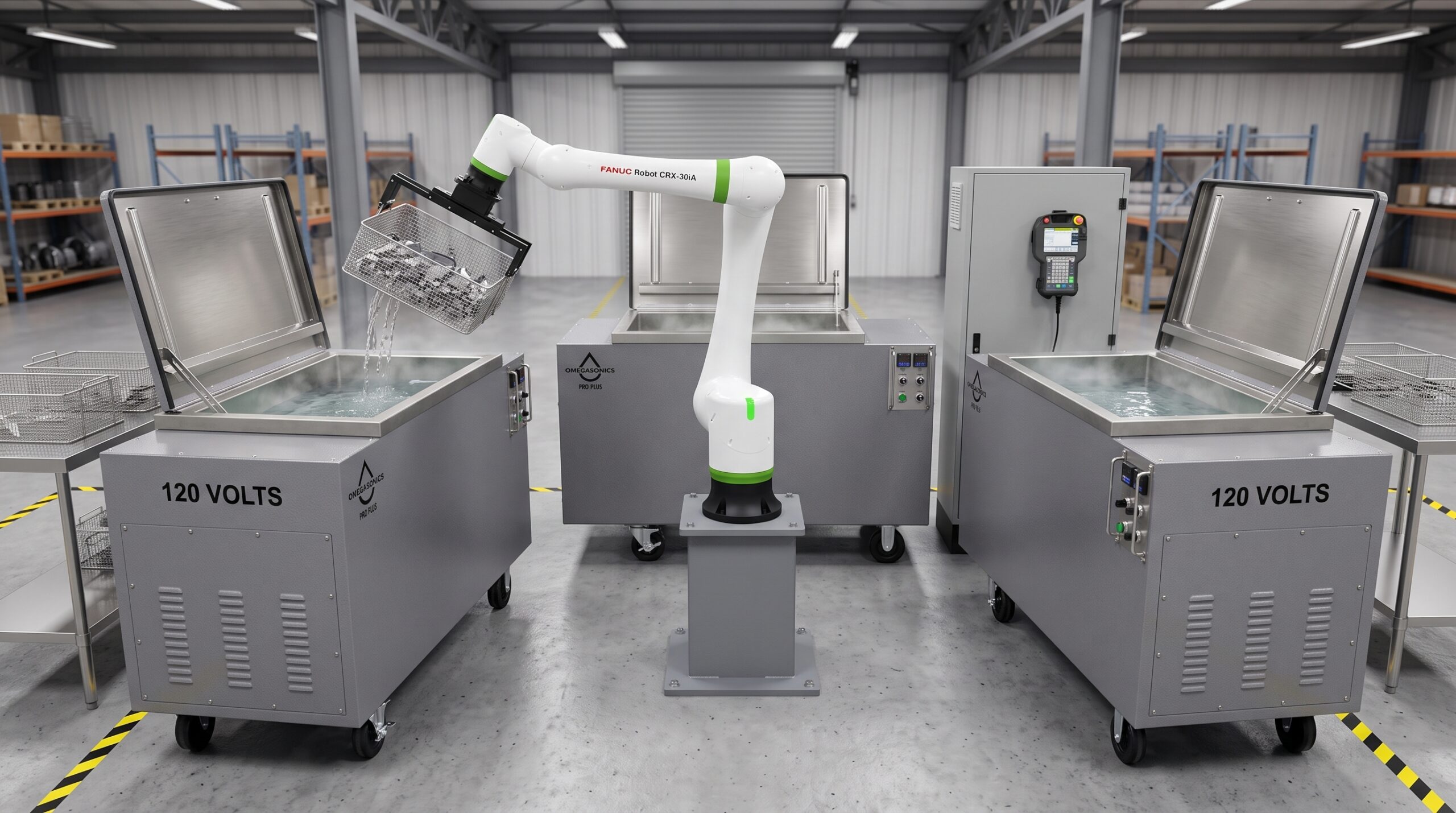
Concept showing robotic basket handling integrated with industrial ultrasonic cleaning equipment.
LOOKING FOR CLEAN-LINE AUTOMATION?
One Conversation. The Right Automation Solution.
Whether you need an automated ultrasonic cleaning system, robotic basket handling or a complete industrial parts cleaning line, start with Omegasonics.
We work with automation specialists and established equipment partners around the globe. We’ll review your application and determine whether the right approach is an Omegasonics system, Omegasonics working with an integrator, or a solution from one of our partners.
Talk With Us About Automation →
No need to know which solution fits before reaching out.
Less repetitive basket handling
Keep parts moving through production
Repeatable cleaning sequences
Build cleaning around demand
Why Automate Ultrasonic Parts Cleaning?
Manufacturers have automated machining, welding, assembly, inspection, packaging and material
handling. Yet in many facilities, parts cleaning still depends heavily on manual labor.
An employee may load a basket, lower it into a cleaning tank, wait for the cycle, remove the
basket, allow it to drain and then carry or transfer it to the next process.
That approach may work well at lower production volumes. But as manufacturing output increases,
manual parts cleaning can become a bottleneck.
An automated ultrasonic cleaning system combines the cleaning power of ultrasonic
cavitation with robotic or automated material handling to create a more repeatable industrial
cleaning process.
The goal isn’t simply to put a robot next to an ultrasonic cleaner.
The goal is to build a complete cleaning process capable of delivering the required cleanliness
and production rate with less unnecessary labor, handling and process variation.
The Advantages of Automated Ultrasonic Cleaning
Reduce Direct Labor
Reduce the employee time spent repeatedly lifting, lowering and moving baskets between
cleaning stages.
Increase Throughput
Coordinate cleaning cycles and transfers around production requirements rather than
operator availability.
Improve Consistency
Programmed cleaning times and repeatable transfers help reduce variation between
operators and shifts.
Reduce Manual Handling
Automation can reduce repetitive basket lifting, lowering and transferring throughout
the production day.
Increase Production Capacity
Automated handling can help cleaning keep pace with CNC machining and other
high-volume manufacturing processes.
Create a Scalable Process
Increasing production does not always have to mean adding cleaning labor at the same rate.
From Ultrasonic Cleaner to Automated Clean Line
A robotic arm, collaborative robot, automated lift or other material-handling system can move
standardized baskets through a programmed cleaning sequence.
LOAD
ULTRASONIC CLEAN
RINSE
DRY
UNLOAD
Depending on the application, a clean line can also incorporate prewashing, multiple ultrasonic
stages, ultrasonic rinsing, filtration, DI-water final rinsing, passivation and specialized drying.
Let the Ultrasonics Clean. Let the Robot Move.
The robot doesn’t need to clean the individual components. Its job can be much simpler:
reliably move the basket through the cleaning process.
A robotic system can potentially pick up a loaded stainless-steel basket, lower it into an
ultrasonic tank, wait for the programmed cleaning cycle, raise the basket, allow the solution
to drain and then transfer the basket to the next process stage.
That division of work is one reason ultrasonic cleaning can work well with automation.
The ultrasonic cleaner provides the cleaning action. The automation provides consistent
material movement.
Automation ROI: What Does Manual Parts Cleaning Really Cost?
The cost of manual parts cleaning is not limited to an employee’s hourly wage.
Employers may also need to account for payroll taxes, benefits, workers’ compensation,
overtime, training, turnover and the productive work an employee could otherwise be performing.
There is also the cost of waiting. If machined parts are ready for cleaning but the employee
responsible for moving baskets is working on something else, both the parts and cleaning
equipment may sit idle.
The better automation question isn’t simply, “How much does a robot cost?”
It is also: “How much are we spending every year performing repetitive cleaning
and material-handling tasks that could potentially be automated?”
Example: 4 Hours of Cleaning Labor Per Shift
At an example fully burdened labor rate of $35 per hour, four hours of direct
cleaning-line labor per day represents the following annual labor costs when operating
260 days per year:
1 Shift / Year
2 Shifts / Year
3 Shifts / Year
These figures are illustrative examples only. Actual labor savings depend on wages, benefits,
production schedules, number of shifts and how much operator involvement can realistically
be reduced.
High-volume manufacturers should evaluate automation based on
total cost of ownership, labor hours per part and cost per cleaned part,
rather than equipment purchase price alone.
Why Ultrasonic Cleaning Works Well With Automation
Ultrasonic cleaning uses high-frequency sound energy transmitted through a liquid cleaning
solution to produce microscopic cavitation bubbles.
As those bubbles form and collapse, they create cleaning action throughout the solution and
against the wetted surfaces of the parts.
This can make ultrasonic cleaning particularly useful for complex components containing:
Blind Holes
Threads
Small Openings
Recesses
Internal Passages
Complex Geometries
Crevices
Machined Surfaces
Once an effective cleaning process has been established, automation can help repeat that
process basket after basket.
Repeatability Can Be Just as Valuable as Labor Savings
Reducing labor is one reason to investigate automation, but
process consistency can be equally important.
A manually operated cleaning line can vary from employee to employee and shift to shift.
One basket may stay in the ultrasonic tank longer than another. One operator may allow the
basket to drain completely while another transfers it immediately.
An automated cleaning line can be programmed around defined process parameters:
Automation should repeat a proven cleaning process—not simply automate a bad one.
Automated Drain Time Can Reduce Chemical Carryover
Look closely at the robotic basket in the image at the top of this page. The basket is positioned
so liquid can drain from the load.
That is an important consideration when designing a multi-stage automated clean line.
Moving a wet basket immediately from a cleaning tank into a rinse tank can carry cleaning
solution into the rinse stage. This is commonly referred to as drag-out.
An automated sequence can include a programmed drain period above the cleaning tank before
transferring the basket. Basket geometry, part orientation and transfer position can also be
engineered to promote drainage.
Controlling drag-out can help:
- Reduce chemical carryover
- Maintain rinse quality
- Reduce cross-contamination between stages
- Potentially extend the useful life of rinse water
Don’t Let Parts Cleaning Become Your Production Bottleneck
Increasing machining capacity only helps if downstream cleaning can keep up.
Manufacturers invest heavily in faster CNC machines, robotic machine tending and other automated
equipment to increase output. But increasing machining capacity can simply move the bottleneck
downstream.
If parts are manufactured faster than they can be cleaned, baskets begin waiting, work-in-process
increases and additional labor or overtime may eventually be required.
DON’T ASK ONLY
THE BETTER QUESTION
From there, the cleaning process can be evaluated around basket capacity, ultrasonic cycle time,
tank size, number of process stages, transfer time, rinsing and drying requirements.
Can Ultrasonic Cleaning Become Part of Lights-Out Manufacturing?
Manufacturers increasingly use automation to extend production hours while reducing the amount
of continuous operator involvement required.
Machining centers can be robotically loaded. Finished parts can be automatically unloaded.
Inspection and material movement can also be automated.
Why should parts cleaning automatically remain a manual process?
A properly engineered automated ultrasonic cleaning system may allow cleaning to become another
integrated stage in a highly automated manufacturing environment.
True unattended production, however, involves more than adding a robot. Tank levels, solution
condition, filtration, heating, drying, basket availability, downstream capacity, controls,
alarms and machine safety all need to be considered.
Manual Parts Cleaning vs. Automated Ultrasonic Cleaning
| Process Consideration | Manual Cleaning | Automated Clean Line |
|---|---|---|
| Basket Transfers | Performed by employee | Can be robotically controlled |
| Cycle Timing | Operator dependent | Programmed and repeatable |
| Direct Labor | Higher operator involvement | Potentially lower labor per cycle |
| Repetitive Lifting | Manual handling | Can be handled by automation |
| Drain Time | Can vary | Can be programmed |
| Process Consistency | Can vary between shifts | Repeatable sequence |
| Scaling Production | May require additional labor | Automation can support increased throughput |
Don’t Start With the Robot. Start With the Part.
The correct automated ultrasonic cleaning system begins with understanding
what needs to be cleaned and how many clean parts production requires.
Important considerations can include:
Build the cleaning system around the application—not the other way around.
Basket Design Matters in Robotic Ultrasonic Cleaning
In an automated cleaning system, the basket is more than a container.
It becomes part of the automation.
The basket or fixture needs to hold the parts correctly while also providing predictable
pickup points for robotic handling.
Part Orientation
Ultrasonic Exposure
Solution Access
Drainage
Robot Gripping
Load Capacity
Part Protection
Throughput
Packing as many parts as possible into a basket is not always the best solution.
Cleaning solution and ultrasonic energy need access to the surfaces being cleaned.
Proper loading, spacing and fixturing can be critical to both cleaning performance
and automation reliability.
Industries That Can Benefit From Automated Ultrasonic Cleaning
Precision-machined components and complex geometries.
Machined components, oils, coolant and production contamination.
Cleaning before inspection, coating, finishing or assembly.
Suitable post-processing and cleaning applications.
Repeatable cleaning for automated production cells.
Cleaning during teardown, inspection, rebuilding and assembly.
When Does Automated Ultrasonic Cleaning Make Sense?
Not every ultrasonic cleaning application needs robotics. For lower-volume cleaning,
a manually operated ultrasonic cleaner may still be the most practical solution.
Automation becomes increasingly worth evaluating when a facility has:
High production volume
Multiple shifts
Repetitive basket movement
High direct labor costs
Heavy baskets
Multiple cleaning stages
Cleaning bottlenecks
Labor availability challenges
Existing automation
Plans to increase production
Not Every Automation Project Needs the Same Solution
Some manufacturers need a custom ultrasonic tank or a multi-stage cleaning line. Others need robotic loading, conveyor integration, advanced controls or a broader automated production cell. We want to understand your cleaning challenge first, then identify an appropriate path.
Omegasonics
An industrial ultrasonic cleaning system or custom clean line designed around your parts and process.
Omegasonics + Integrator
Ultrasonic cleaning equipment combined with robotic handling or other automation engineered with an integration specialist.
Partner-Led Solution
When another specialist is better suited to your requirements, we can discuss connecting you with an appropriate partner.
Our wider network includes automation and industrial cleaning specialists, including Innovated Manufacturing and established industry relationships with Jayco and Miraclean. The specific equipment, integration responsibilities and project fit are evaluated case by case.
Share your parts, contamination, production rate and desired level of automation. We’ll help determine the next conversation.
Automated Ultrasonic Cleaning FAQ
What is an automated ultrasonic cleaning system?
It combines ultrasonic parts cleaning with automated material handling. A robot, automated
lift, hoist or other transfer system can move parts or baskets through cleaning, rinsing,
drying and other process stages.
Can a robot load an ultrasonic cleaner?
Yes. With the proper system design, robotic material handling can load and unload baskets
or fixtures and transfer them between process stations. Payload, reach, tooling, environment
and safety requirements must be evaluated for the application.
Can automated ultrasonic cleaning reduce labor costs?
Potentially. Ultrasonic cleaning can reduce manual cleaning work, while automation can
reduce the direct labor associated with repeatedly lifting and moving baskets between stages.
Actual savings depend on the specific process.
Can an existing ultrasonic cleaning process be automated?
Potentially. Existing equipment, tank layout, basket design, controls, floor space and
production requirements should be evaluated to determine whether automation can be integrated
effectively or whether a new clean line is more practical.
What processes can be included in an ultrasonic clean line?
Depending on the application, a clean line can incorporate prewashing, ultrasonic cleaning,
multiple cleaning stages, ultrasonic rinsing, heated rinsing, DI-water rinsing, filtration,
passivation and drying.
Can automated ultrasonic cleaning increase production?
If manual cleaning or basket handling is limiting production, automation can help reduce
waiting between stages and keep parts moving through a defined cleaning sequence.
Can Omegasonics help if my project requires a robotic integrator or another cleaning-system supplier?
Yes. Start by telling us about your parts, cleaning requirements and production goals. We can assess whether to propose Omegasonics equipment, explore a solution with an integrator, or discuss a referral to a partner whose capabilities may fit your project.
Does Omegasonics build custom ultrasonic cleaning systems?
Yes. Omegasonics manufactures industrial ultrasonic cleaning equipment and custom cleaning systems. For broader automation projects, we evaluate whether to work directly, collaborate with an integrator or connect you with a partner.
Ready to Automate Your Parts Cleaning Process?
Tell Omegasonics what you’re cleaning, what you’re removing, your current cleaning process
and how many parts you need to process per hour. We will evaluate whether Omegasonics, a joint solution with an integrator, or an established partner is a good fit for your application.